In cross-border inheritance matters, even where the right of inheritance itself is undisputed, the commencement and advancement of litigation often face more complex obstacles than in domestic cases, including the identification of a proper defendant, notarization and authentication of overseas documents, and the determination of court jurisdiction. The absence of any one of these elements may prevent the case from being accepted by the court or cause prolonged delay.

In this case, the U.S. client, as the lawful heir, sought to inherit a property in Beijing left by her mother in accordance with law. Due to the pronounced foreign-related nature of the inheritance matter, and because the case faced multiple procedural issues at the litigation commencement stage, including the identification of a proper defendant, confirmation of the legal validity of overseas evidentiary documents, and coordination with court procedures, the matter was once difficult to move forward. The client therefore engaged Attorneys Larry Zhou and Avon Zhao to provide full-process legal services.
After accepting the engagement, the core issue faced by Attorneys Larry Zhou and Avon Zhao was not any substantive dispute over inheritance rights, but rather the procedural requirement under Chinese courts for a “proper defendant” in inheritance litigation. In the absence of an executor and any other disputing heirs, the legal team identified a viable path to move the litigation forward by designating a second-order heir as a procedural defendant. To this end, the attorneys proactively assisted the client in contacting her relatives and, through repeated patient communication and legal explanation, ultimately persuaded them to agree to participate in the case as parties. This key breakthrough laid a lawful procedural foundation for the filing and adjudication of the case.
At the same time, the legal team assisted the client in completing the notarization, authentication, and translation preparation of overseas documents, including proof of identity and proof of kinship, thereby facilitating the smooth entry of the case into court proceedings. In the course of handling the matter, the team not only completed the design of the inheritance litigation strategy and communications with the court, but also actively coordinated the follow-up implementation steps. Ultimately, they assisted the client in obtaining an effective legal instrument issued by the court confirming her lawful inheritance rights to the Beijing property at issue.
Thereafter, the legal team continued to assist the U.S. client in preparing the materials required for real estate registration and worked with the relevant registration authorities to complete the transfer of title, ultimately and successfully transferring the property into the client’s name.
The successful resolution of this case effectively protected the lawful rights and interests of a foreign client in inheriting and disposing of real property within China, and also demonstrated the legal team’s professional capability and practical experience in foreign-related inheritance matters, family dispute resolution, and coordination with real property registration procedures. For inheritance matters involving cross-border identity issues, overseas evidence, and procedural obstacles, lawyers’ full-process involvement is of great significance in securing both legal confirmation of rights and the practical realization of assets.
Practical Suggestions for Foreign Clients Handling Assets in China
Based on this case and the team’s experience in handling multiple cross-border inheritance matters, we summarize the following practical points for foreign clients, including former Chinese citizens who have acquired foreign nationality, when dealing with estate assets located in China:
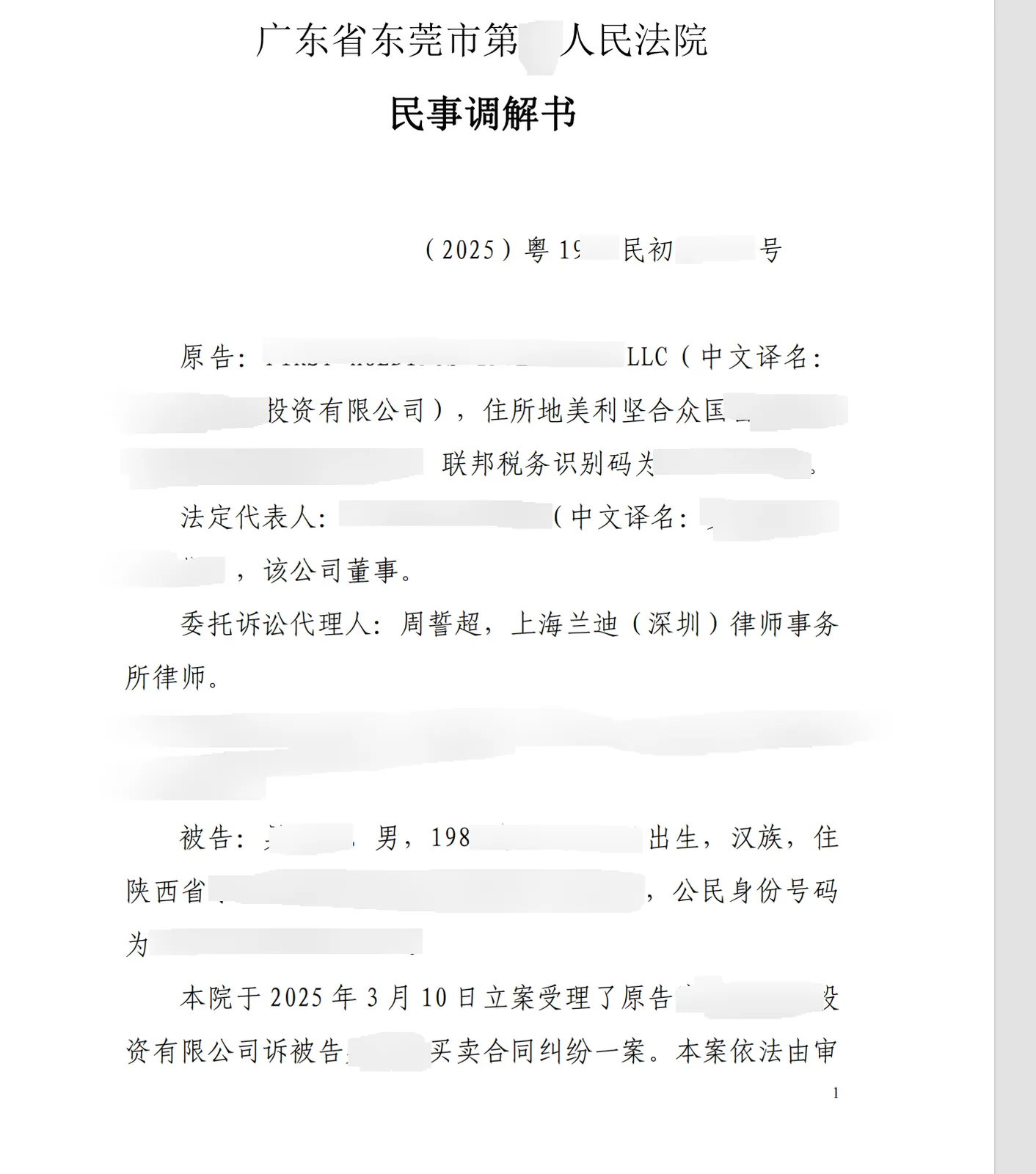
Inheritance of Real Property: Even where there is only one heir, including situations involving both first-order and second-order heirs, if the heir cannot return to China in person, China’s real estate registration authorities will generally accept only an effective court judgment or mediation statement. A notarized will or notarized certificate of inheritance may not be directly usable in practice without litigation.
Inheritance of Bank Deposits: Even if the heir possesses the deceased’s bank card and password, banks generally do not permit direct withdrawal of funds or account closure. It is first necessary to apply to the court for an investigation order to obtain detailed account opening information and account balances under the deceased’s name, and only after inheritance rights are confirmed by court judgment can the relevant procedures be completed.
Searching for Other Accounts in the Deceased’s Name: The People’s Bank of China does not accept inquiries from individuals and only handles institution-to-institution inquiries. Courts also generally do not proactively conduct a comprehensive search for all bank accounts held by the deceased. In practice, heirs still need to return to China in person and bring relevant supporting documents to inquire with banks one by one at the counter.
Entrusting Others to Handle Real Property Transfer: After a court judgment confirms ownership of the inherited property, the heir does not need to return to China in person to complete the title transfer and may authorize another person to handle it on his or her behalf. The power of attorney itself does not need to be notarized or authenticated. However, the heir’s valid original passport and a statement confirming “the passport holder and the same person” must be apostilled and accompanied by a notarized Chinese translation before they will generally be accepted by the real estate registration authority.
Sale of Real Property in China: If the heir plans to sell inherited real property in China, the heir must ensure that he or she has a valid RMB bank account opened in mainland China. Otherwise, it is generally not possible to authorize a third party to receive the sale proceeds, nor is it generally possible to notarize an arrangement for “collection of sale proceeds on behalf of another.” In practice, most notary offices will not accept such instructions.
Cross-Border Transfer of Assets: If the heir wishes to lawfully transfer all inherited assets in China out of the country, he or she must return to China in person to communicate with the bank, the State Administration of Foreign Exchange, and the tax authorities on a step-by-step basis, and apply for and obtain the foreign exchange registration and approval required under the “capital transfer” category before a large lawful outbound remittance can be completed.
Need legal help in China?
Tell us your situation — free and private consultation, reply within 12 hours.